Commit
Real-Time Technical Interview Platform
PersonalFull Stack DeveloperJan 2024 - Jan 2024
Next.js 16TypeScriptReactConvexClerkStream(video SDK)Monoco EditorTailwind cssShadcnDocker
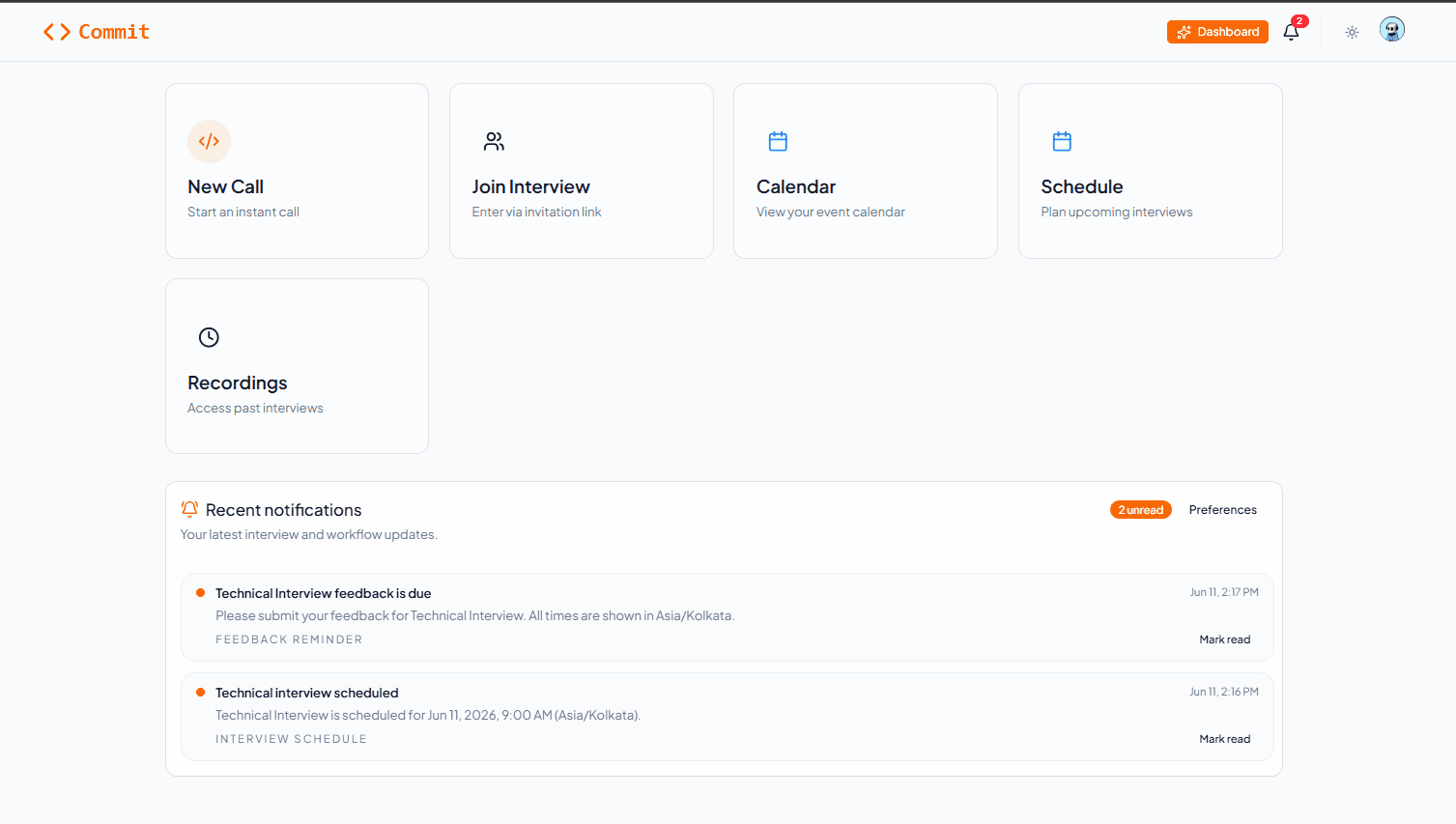
I built a platform for running technical interviews end to end — scheduling, live video, collaborative coding, and structured feedback. The interesting problem was never the CRUD; it was running a stranger's code on my own server without handing them the host. Here's how the pieces fit together.
The shape of the system
- Next.js (App Router) serves the UI and a set of API routes.
- Convex is the backend — a reactive document database plus the server functions that hold the business logic (~4.3k LOC), including HTTP actions for inbound webhooks.
- Clerk handles auth, Stream powers video and recordings, SMTP (via nodemailer) sends email, and the host Docker daemon runs candidate code.
Five roles — candidate, interviewer, recruiter, developer, admin — drive everything from routing to which dashboard you land on.
Running untrusted code without losing the host
The core feature is a Monaco editor where candidates write and run JS, Python, or Java live. That means executing untrusted input on
every "Run". Because the app talks to the host Docker daemon over a mounted socket, I deliberately don't bind-mount the candidate's
code — I pipe it in over stdin, so there's no host path a container can reach back into.
Every run is an ephemeral container locked down hard:
docker run --rm -i \
  --network none \                     # no network at all
  --memory 128m --memory-swap 128m \   # capped, swap disabled
  --cpus 0.5 --pids-limit 64 \
  --cap-drop ALL --security-opt no-new-privileges \
  --read-only --tmpfs /tmp:size=32m \
  <runner-image>
# plus a 10s wall-clock timeout and capped output size
The runner also separates failure modes deliberately: a broken sandbox returns 503 (our problem), while a candidate's syntax error or crash returns 200 with the captured output (their code's problem). The UI never confuses "your code failed" with "our platform failed".
Making the socket usable without running as root took a build-time trick: the Dockerfile installs the docker CLI and matches the container's docker group GID to the host's at build time — falling back gracefully on a GID collision — so the app runs as a non-root user but can still reach the daemon.
Authorization at the edge
Access control runs before the page does. Clerk middleware resolves the signed-in user, then queries Convex for their role and
enforces route access in middleware.ts, injecting a correlation ID for tracing along the way. Unauthorized roles are redirected before
a protected page ever renders — no reliance on scattered per-page checks.
Live interviews and scoring
Video, calls, and recordings run on Stream, brokered through server actions so tokens never reach the client. Hosts get an explicit "end meeting" action, and recordings are retained per interview under a retention policy. Interviewers evaluate candidates with weighted scorecards — shared vs private notes, and pass / reject / hold / review outcomes — which feed a hiring-pipeline workspace with a funnel and filters.
Treating it like production, not a demo
A lot of the work went into the boring, load-bearing parts:
- Webhook idempotency — Svix signature verification, dedupe by event id, and a receipt → processed → failed state machine with queued recovery, so a retried Clerk or Stream webhook can't double-apply.
- An observability layer — operational events, integration health checks, audit logs for sensitive actions, and background-job tracking.
- Runtime env validation — separate optional (dev) and strict (prod) Zod schemas, with the check skipped during
next buildso the image builds without secrets present. - A backup sidecar — the same image runs a cron job that calls
convex export, prunes by retention, persists to a named volume, and reports each snapshot back to the app over an authenticated internal endpoint.
Build and deploy
CI runs tsc --noEmit and the unit suite on every push. The deploy workflow builds an arm64 image on a native ARM runner, pushes it to
a container registry, and the stack runs from there as two services — app plus the backup sidecar — behind a reverse proxy and gated on
an /api/health check.
What's next
The honest gap is test coverage: there's a small unit suite (error handling, feature flags, rate limiting) but no component or end-to-end tests yet. Given how much of the product's value lives in the live interview flow, that's the next thing I'd build out.